Available on the App Store

Overview

Galileo Offline Maps is a map browsing app you can use offline. It makes life easier, when driving without any GPS or Internet connection, because you can use previously saved offline maps in your mobile iOS devices.

When you have to plan your trips in advance – just select the desired area on the map to download to your computer, mark it with waypoints and routes, and import them into your iPhone, iPad or iPod Touch.

Galileo Offline Maps also helps you keep all your data organized – you can sort bookmarks and GPS tracks into collections, like folders on your desktop.

App at a Glance

Galileo Offline Maps Overview

Note: to view the app introduction tour within the Galileo Offline Maps, tap the Help > Take a tour option in the app Settings.

To move the map – drag it with your finger in the direction you want to position the map:

Move the map

To zoom in – use double tap or pinch your thumb and finger apart:

Zoom in

Tip: to zoom in with one hand, double-tap a map and drag your finger up.

To zoom out – double tap or pinch your thumb and finger together:

Zoom out

Tip: to zoom out with one hand, double-tap a map and drag your finger down.

Finding your Location

To locate your current approximate position on the map and enable the tracking mode – tap the My Location button:

My Location icon

The position marker displays on the map, showing your current location. If your location cannot be determined precisely, a color circle also appears around the marker. The size of the circle depends on how accurately your location can be determined: the smaller the circle – the greater the accuracy.

Position on map

Once tracking mode is enabled, app centers the map on your location and tracks your position as you move.

To turn off tracking mode, just touch and move the map.

Enabling Compass Mode

Compass mode

To enable the compass mode – double tap on the My Location button and the map will orient itself in the direction you are currently facing. To turn off compass mode – just touch and move the map or tap again on the My Location button.

Note: walls, metal roofs, tall buildings and other obstructions can block line of sight to GPS satellites and affect compass accuracy. Therefore, try to maintain a clear view of the horizon in several directions.

Enabling Location Services

No GPS icon

Every time you see this icon, it means that your GPS cannot currently get an internet signal. It may also appear when Location Services is disabled on your device. Enable Location Services in the system Settings to allow the application to determine your location.

Note: in iOS 6 go to Settings > Privacy > Location Services.

Search icon

Galileo Offline Maps lets you search for an address or POI while online. Tap the search icon to reveal the text field and bring up the keyboard. Type in a query, then tap Search.


Search Field

Address search

An address search query should be specified as a set of address parts separated by commas. Search terms are processed left to right in the following format: Street, City, Country.

Use house numbers where they have been defined for an area:

POI local search

You can also search a place within the currently visible map area such as: night club, shop, ATM, etc. If search cannot find any result, the app will show all available results on the map.

You can also search POI using special phrases in English or in your native language, such as:

See the full list of supported special phrases on OpenStreetMap Wiki page.

Note: Search results depend on the OSM data service from whom the information may be unavailable, inaccurate, or incomplete.

Read also: Why is nothing found for my search?

Search by GPS coordinates

If you know the exact coordinates of a location, you can simply enter them into the search field to locate it on map. You may enter the coordinates in any of supported coordinate formats.

Search by coordinates

Viewing Search Results

All the results found in a search are shown within the currently visible area on map. To see the results in list view, tap the Search results icon icon just to the right to search query:

Search results on map Search results list

Note: search results are limited and no more than 20 records will be returned per search in order to reduce server load.

To open search results details screen:

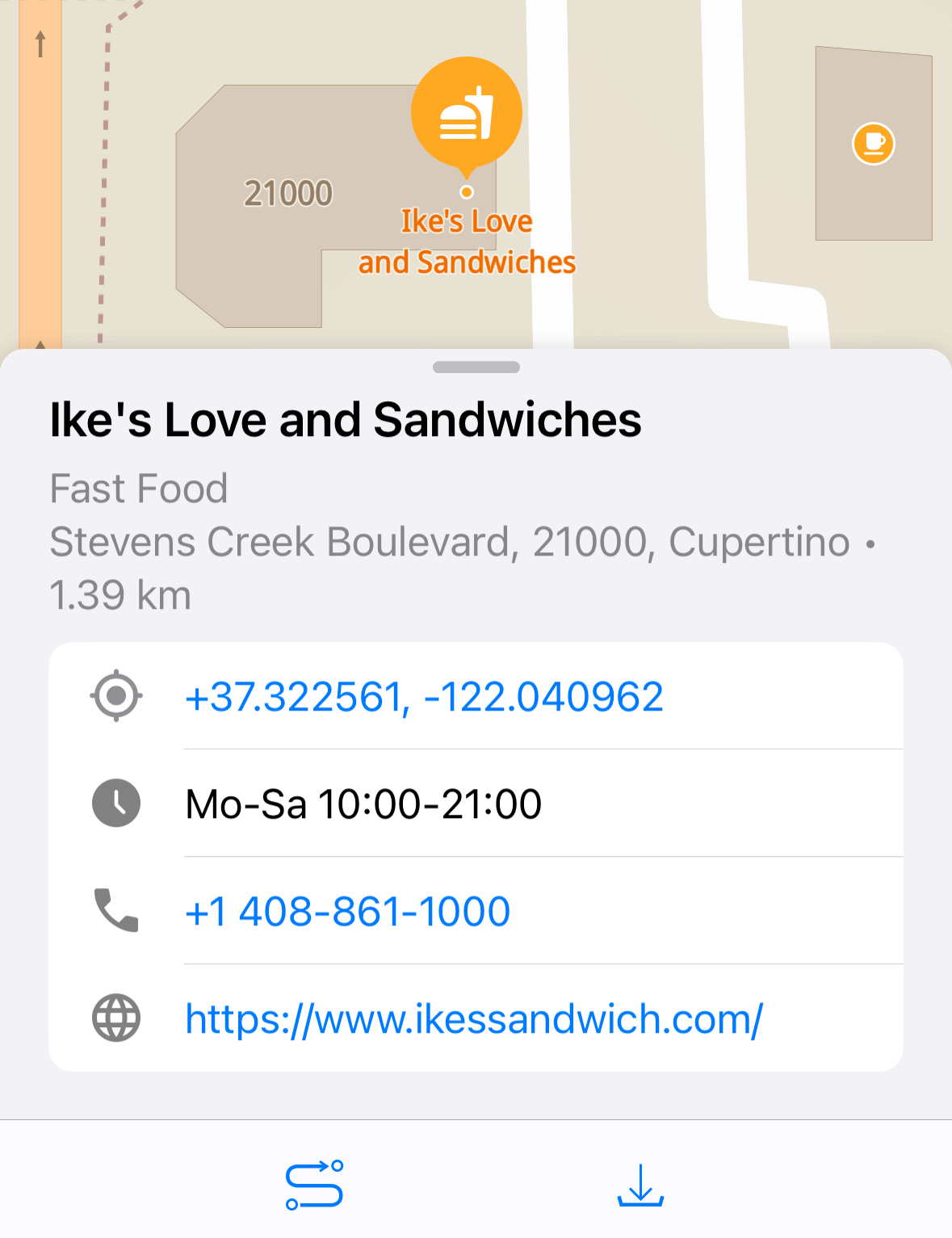
Search result details

Available actions:

Note: To save the search result to bookmarks, make sure that the Bookmarks feature is enabled.

Deleting Search Results

You can either delete all search results from map or one specific result.

To delete an entire search results from map:

Clear search results

To delete one specific search result:

Delete one search result from list
back to top

Working with Online Maps

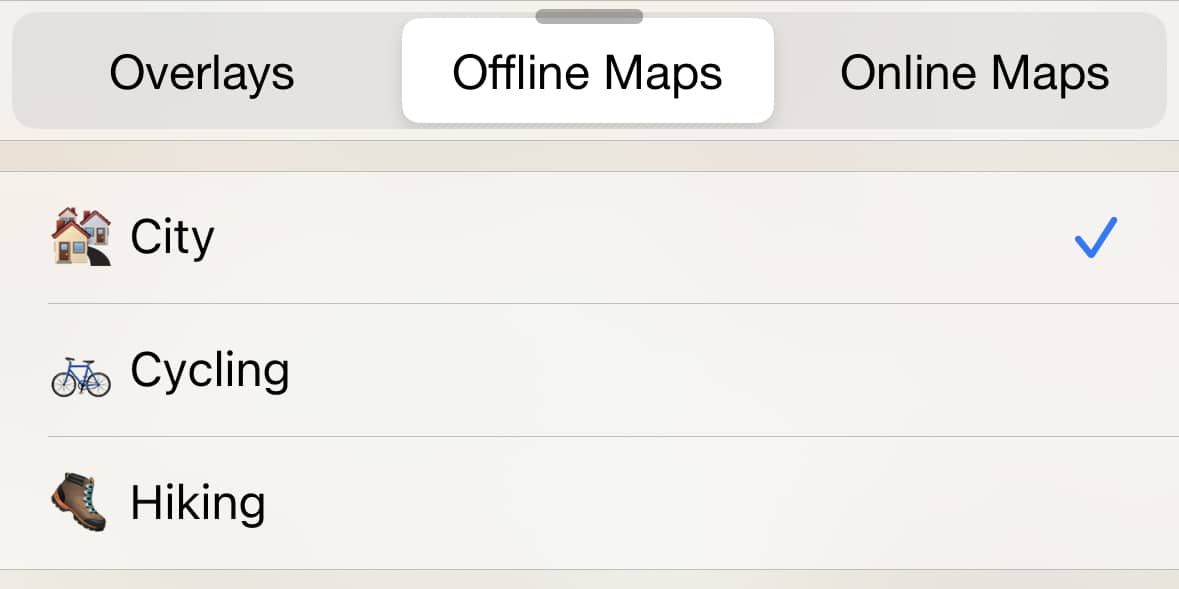
To switch between map sources and select the map which is the best one for you, go to Settings > Map Source.

Note: map download speed can vary while using an online sources, and depends on the speed of your Internet connection and the speed of the server from where the map is downloaded.

Built-in Online Maps

Maps from the following sources are available online by default:

Note: all CloudMade map sources are available in high-definition quality on devices with Retina display.

Custom Online Maps

In addition to built-in maps, Galileo Offline Maps also supports custom online maps. You can add any map source you like using a special XML file that contains description of map provider.

Custom XML Map Source

The following example shows how the XML file for OpenStreetMap source may be defined:

<?xml version="1.0" encoding="UTF-8"?>
<customMapSource> 
<name>OpenStreetMap</name> 
<url>http://{$serverpart}.tile.openstreetmap.org/{$z}/{$x}/{$y}.png</url> 
<serverParts>a b c</serverParts>
</customMapSource>

The most important tags of this definition are described below:

How to add

There are several ways to add custom online map source to the app:

  1. Place the XML file in the app shared folder in iTunes.
  2. Open the XML file attached in Email on your device using the "Open in Galileo" option.
  3. Open the XML file from Dropbox on your device using the "Open in.." option.

As a result, the new map source will appear in Map Source list.

Read also:
Adding Google Maps and Bing Maps sources.

Reordering Map Sources

Map sources in list are displayed in alphabetical order by default. Tap the Reorder button in the upper right hand corner of the Map Source screen and you will have the option to delete existing offline maps as well as a new option for reordering map sources. Three lines indicates that row can be dragged to another location in the table – tap it and hold for a moment to change the order of map sources in list. Tap the Done button when finished.

Reordering map sources
back to top

Working with Offline Maps

There are two options to get an offline map on your device:

Thanks to these options your map can be viewed offline even when your mobile device has no internet connectivity.

Saving Maps

Caching is always enabled – the app saves all recently viewed map images (the tiles that make up the map) in your cache and keeps them available for offline usage.

To save maps – navigate to the area you are going to visit and zoom-in while you have access to the Internet. All loaded map tiles will be automatically saved to your device's storage and can be managed in Settings > Cache Info, so you can delete the tiles you no longer need if you want to free up storage space.

About Offline Maps Import

Offline Maps Import feature, available as an in-app purchase, allows you to import custom offline maps, in .sqlitedb or .mbtiles format, for offline use.
To enable this functionality go to Settings > Paid Features and tap the Buy button behind the Offline Maps Import feature.

Creating an Offline Map

The main idea is to create an offline map for the desired area in advance with one of the following tools on your computer:

Creating an Offline Map with MOBAC

Mobile Atlas Creator (MOBAC) – is free software that allows you to download maps from numerous map sources, and save them in the .sqlitedb format used by Galileo Offline Maps. This tool is compatible with Windows, Mac OS X and Linux.

Getting MOBAC

  1. Download the latest version from the official MOBAC website.
  2. Extract the content of the .zip archive on your computer.

Launching MOBAC

MOBAC atlas format

If you are using:

After starting the MOBAC program enter the name of the offline map you are going to create, then select Galileo Offline Maps atlas format.

To work with the map in MOBAC use:

Follow the steps below to create your own offline map for a desired area:

  1. Select the map source you want to use for your offline map
  2. Select the zoom levels you want to save (normally, it is enough to select 1-15)
  3. Select an area on the map you want to download
  4. Click Add Selection (clear previous selections if applicable)
  5. Click Create Atlas to start the map creation process.
    MOBAC guide
  6. When done, open the atlases folder in the Mobile Atlas Creator directory – and the .sqlitedb file, with the created offline map, will be available and ready for use.
    Creating offline map

Read also:

Creating an Offline Map with TileMill

TileMill (by MapBox) – is a desktop application for cartographers to quickly and easily design and create stunning offline maps in the .mbtiles format supported by Galileo Offline Maps. It is completely compatible with Mac OS X, Windows and Ubuntu.

To learn how to create an offline maps in .mbtiles format, please refer to the TileMill manual.

Importing an Offline Maps

Once you have created an offline map, you should upload it on your device. There are two ways to import an offline map into your device:

Importing using iTunes

Connect your device to your computer, launch the iTunes application and perform these steps:

  1. Open the iTunes application and select your device (to restore traditional sidebar view in the latest version of iTunes open the View option from the menu bar and select Show Sidebar)
  2. Go to the Apps tab and scroll down
  3. Select Galileo in the Apps list
  4. Add the file with the offline map into the Galileo Offline Maps shared folder.
    Import offline map with iTunes

Note: to delete an offline map from the list, select it and press the Backspace (Delete) key.

Importing with Dropbox

In addition to iTunes sync, there is another handy way to upload your offline maps into the Galileo Offline Maps, if you are a Dropbox user.

Dropbox is a file-synchronizing service that lets you keep your files in sync between your computer and iOS devices with 2GB storage for free. Dropbox allows you to upload offline maps into the app.

Import offline map with Dropbox
  1. Put the file with the created offline map, in .sqlitedb/.mbtiles format, in the Dropbox folder on your computer
  2. Open the Dropbox folder on your iOS device
  3. Wait until the file you placed there is synchronized automatically between the devices
  4. Select the offline map you would like to import
  5. Tap the icon Open in.. depicting an arrow exiting a box
  6. Select the Galileo option to initiate the import process.

Using Offline Maps

Using offline map

To use offline maps on your device, make sure you have purchased the Offline Maps Import feature in Settings > Paid Features:

  1. Launch the Galileo Offline Maps application on your device
  2. Go to Settings > Map Source. The pre-saved offline map will appear in your list
  3. Select it and navigate around the downloaded area.

Troubleshooting

Sometimes you can see empty map areas (tiles), with the following warning messages on the map:


back to top

Settings

Settings lets you configure Galileo Offline Maps, set app options, purchase additional features and manage map data.

Setting Up the Network Mode

Network Mode setting

Changing Units & Coordinates Format

Show coordinates on map

To set the units system and coordinates format you would like to use within the Galileo Offline Maps, go to Settings > Units Format.

Units system

Coordinates format

In Galileo Offline Maps you can choose to represent your coordinates in any way you like. The coordinate format you select will be used to display all coordinates within the app.

An example of different coordinate formats for New York city follows:

Show on map

You can also turn on/off the real-time display of coordinates on the map – switch ON to show the coordinates on the map.

Setting Default Styles

Default styles for tracks and bookmarks

To set a default color for GPS tracks and category for bookmarks, go to Settings > Default Styles.

Default track color

Selected color is a default line color for newly recorded GPS tracks, and default color for position marker on map.

Default bookmark category

Selected icon is a default icon for newly created or imported bookmarks.

Filtering GPS Data

Galileo Offline Maps app supports GPS data filtering in Settings > GPS Filtering:

Accuracy Threshold

Filter by the minimum accuracy at which the new points will be accepted. New points will be added to GPS track if the accuracy is lower than selected (recommended value is 150 m).

Accuracy Threshold

Example: You are recording your GPS track while walking around your neighborhood and you have entered a supermarket. Tall walls, roofs and other obstructions can block the signal from GPS satellites and the device cannot determine your location accurately enough. You may enable the accuracy filter to set the required accuracy and ignore inaccurate GPS data. If the received signal has lower than the required accuracy, that point will not be recorded in the track.

Distance Threshold

Filter by the minimum distance travelled before a new point will be recorded. New points will be added to GPS track when the distance between them is greater than selected (recommended value is 5 m).

Distance Threshold

Example: You are recording your GPS track while jogging, then you meet a friend and stop to talk to him. As the GPS sends location coordinates every second, too many points will be recorded on the same spot while you are talking, and the recorded track will take up more space. You may enable the distance filter to ignore GPS points if they are too close to each other. New points will start recording as you exceed the distance selected in the filter.

Refreshing Map Data

To set how often to refresh cached map tiles, go to Settings > Cache Info. All tiles older than selected time will be downloaded while browsing online.

Map Refresh

back to top

My Collections

Collections are groups of bookmarks and GPS tracks, like folders on your desktop. Organizing items into collections makes it easy to keep your travel itineraries separate from each other.

My Collections list

Expand & Collapse the Collections List

Use a single tap on the collection name to expand or collapse the collection in the list:

Once a collection is expanded, you are able to view it’s contents just below the folder.

Sort Collections in the List

You can easily sort collections by date created, distance and file name in the list:

Search in List

You can find collections, bookmarks or GPS tracks quickly using the search field above the list:

  1. Tap the status bar at the top of the screen to reveal the search field above the list.
  2. Tap the search field and start typing.

The list will dynamically display collections containing items that match your search criteria as you type.


Search in My Collections list

Create New Collection

You might want to create new collections for an individual trip, country, city or certain set of POIs (e.g. a list of your favourite restaurants).

To add a new collection tap the [+] button above the My Collections list. Enter collection details, then tap Done.

Manage Collection Details

Open the details of collection

Collections details view

To open the collection details screen, just tap the Disclosure button button next to the collection name in the list.

Edit details

Tap the name (or description) field and use the keyboard to enter a new name (or description).

Show collection on a map

To view the entire collection on the main screen, tap the Show button at the top right corner of the collection details screen.

Set a default collection for new records

To set a collection as default and save new bookmarks and GPS tracks to this collection, tap the Default Collection switch to ON.

Show & Hide Collection from Map

To keep maps uncluttered and easy to use, you may choose what to show on the map at any given moment. To hide or show a whole collection at once (in addition to being able to show or hide each individual item in list), go to the collection details screen and tap the cell with the number of bookmarks and tracks currently displayed on the map – a pop-up appears allowing you to Show all or Hide all.


Show and hide collection from map

Delete a Collection

There are two ways to delete a collection:

Export a Collection

Once you have collected a bunch of bookmarks and recorded tracks, you can export them at once for viewing in any other app or for sharing with friends via email.

  1. To export the collection, tap the Export button at the bottom of the collection details screen.
  2. Select the way you would like to save your collection:
    • as an email with an attached file,
    • as a file on your device in the app shared folder.
  3. Then select the export format: KML or GPX.

Read also:


back to top

Bookmarks

The Bookmarks feature, available as an in-app purchase, is a great way to keep your favourite places at your fingertips. Mark places you want to go to or add an interesting place on the go that you could come back to later.

To use bookmarks in the app, go to Settings > Paid Features and tap the Buy button behind the Bookmarks feature.

Create New Bookmark

To create a new bookmark, touch and hold on the map until the pop-up appears, then tap the Place bookmark button.


Place bookmark action

Note: there is another easy way to save a location on map – you can add a bookmark from search results (read: Viewing Search Results).

View Bookmark Name

Tap the bookmark icon on the map to see the bookmark name. Tap it again to hide it.


View bookmark name

Show & Hide Bookmark from Map

To hide a particular bookmark from the map, just tap once on the item name in My Collections list. It turns the font colour from black to gray; i.e. black – for visible, gray – for hidden bookmarks. Tap it again to show the bookmark on map.

Hidden bookmarks

Manage Bookmark Details

Open the details of bookmark

There are two ways to open the bookmark details screen: Bookmark details view

Edit details

Tap the name (or description) field and use the keyboard to enter a new name (or description).

Show bookmark on the map

To view the bookmark on the map, tap Show at the top right corner of the bookmark details screen.

Copy coordinates

Tap the coordinates to bring up the pop-up with available options to copy bookmark coordinates:

Copy coordinates action

Change category

Galileo Offline Maps comes with a range of bookmark icons available to choose from. To change the bookmark icon view, tap the Category field on the bookmark details screen and tap the icon you would like to use.

Change collection

To move a bookmark to another collection, tap the Collection field and select the new name from the My Collections list.

Delete a Bookmark

There are two ways to delete a bookmark:

Export a Bookmark

  1. To export a bookmark, tap the Export button at the bottom of the bookmark details screen.
  2. Select the way you would like to save your bookmark:
    • as an email with an attached file,
    • as a file on your device in the app shared folder.
  3. Then select the export format: KML or GPX.

Note: the best way to export several bookmarks at once is to save them in one collection and export the collection.

Read also:


back to top

GPS Tracks

Galileo Offline Maps lets you record your movements, view detailed statistics and export recorded GPS tracks in most common formats. To record a GPS track in the app, go to Settings > Paid Features and tap the Buy button behind the GPS Track Recording feature.

Record GPS Track

To start recording your GPS track, single tap the REC button on the screen with the map. It changes dot color from gray to red. Tap the REC button again and the recording stops.

Show & Hide Track from Map

To hide a particular track from the map, just single tap the track name in My Collections list. The font color changes from black to gray: black – for visible, gray – for hidden GPS tracks. Single tap again to show the track on the map.

Hidden tracks

Note: continued use of GPS running in the background can dramatically decrease battery life.

Read also: How to reduce battery loss while using the app.

Manage Track Details

Open the details of a track

To open the track details screen, tap the Disclosure button button next to the track name in My Collections list.

Track details view

Edit details

Tap the name (or description) field and use the keyboard to enter a new name (or description).

Show track on map

To view the track on the map, tap the Show button at the top right corner of the track details screen.

Change line color

You can change the color that app uses to display GPS track on map by tapping the desired color. It will help you visually separate a track on map with a simple glance.

Change collection

To move a track to another collection, tap the Collection field and select the new name from the My Collections list.

Delete a Track

There are two ways to delete a track:

Export a Track

Follow these steps to export a GPS track:

  1. Tap the Export button at the bottom of the track details screen.
  2. Choose the way to save your track:
    • as an email with an attached file,
    • as a file on your device in the app shared folder.
  3. Then choose a file format to save as: KML, GPX or CSV.
Once you have exported your track, you can use Google Earth, Google Maps or similar applications to visualize and edit GPS tracks.

Note: the best way to export several GPS tracks at once is to save them in one collection and export the collection.

Read also:


back to top

Getting Exported Files

In order to access the exported collection, bookmark or GPS track:

  1. Connect your device to iTunes
  2. Go to the Apps tab and scroll down to File Sharing section
  3. Select Galileo to view a list of the files exported within the app on your iOS device
  4. Select the file you want to copy to your computer from the Documents list and click the Save to.. button
  5. Locate the folder on your computer to which you want to copy selected file and click the Open button. The selected files will be copied to your computer immediately.
Getting the app shared folder
back to top

Importing KML/GPX Files

You can easily import KML or GPX files into the Galileo Offline Maps app in several ways: from email, weblink or DropBox.

Please note, that the following files could not be imported: KML files with <MultiGeometry>, <Polygon> tags and GPX files with <rte> tag. These tags will be added later.

Import KML/GPX from Email

If you have a KML or GPX file that someone shared with you via email, you can view it in the Galileo Offline Maps app:

  1. Open the message containing the KML/GPX file as an attachment
  2. Tap and hold the attached KML/GPX file’s name until a menu comes up
  3. Choose the Open in Galileo option to initiate the import process.
Importing KML/GPX from email

Import KML/GPX from Web Link

In case you have a web link to the KML/GPX file:

  1. Tap the link to open it in your browser
  2. Tap the button Open in.. on the page after it finishes loading
  3. Choose the Galileo option to initiate the import process
Importing KML from web link

Import KML/GPX from Dropbox

If you store your files in Dropbox, it also allows you to open KML/GPX files on your iOS device:

  1. Open your Dropbox folder on your device
  2. Select the KML/GPX file to import
  3. Tap the icon Open in.. depicting an arrow exiting a box
  4. Choose the Galileo option to initiate the import process.
Importing KML/GPX from Dropbox
back to top

Advanced Working with MOBAC

Mobile Atlas Creator (MOBAC) is an open source (GPL) program which creates offline maps for Galileo Offline Maps app and can use a large number of different online maps such as OpenStreetMap and other online map providers. To learn more about basic features, please refer to Quick Start Manual for Mobile Atlas Creator.

This section is intended for advanced users and contains details to work more efficiently with the app.

Custom Map Sources in MOBAC

Mobile Atlas Creater supports a large number of popular map sources. However, if your favorite online map is not in this list, you can try to add it as custom map source via special XML file.

Put the XML file with defined custom map source to the 'mapsources' directory and relaunch MOBAC program. The new custom map source will appear in Map sources list.

Note: some online map sources are limited by licensing terms, also please take a look into the list of incompatible map sources.

XML template

There is an example how the XML file has to be formatted for an additional map source named Stamen – Toner:

<?xml version="1.0" encoding="UTF-8"?>
<customMapSource>
  <name>Stamen - Toner</name>
  <minZoom>0</minZoom>
  <maxZoom>18</maxZoom>
  <tileType>png</tileType>
  <tileUpdate>IfNoneMatch</tileUpdate>
  <url>http://tile.stamen.com/toner/{$z}/{$x}/{$y}.png</url>
  <backgroundColor>#000000</backgroundColor>
</customMapSource>

Download XML file: Stamen-Toner.xml

Read more: Custom XML Map Sources at MOBAC wiki.

Custom CloudMade map sources

The CloudMade map service offers a large number of OSM based maps with different styles. As each style is accessible through it's styleID (for example style "Fresh" has styleID=997), custom CloudMade maps can be added to MOBAC via a simple XML file containing this styleID. This is a simple example how to use a CloudMade map. You only have to set the styleID and a name that will be displayed in the map sources list

<?xml version="1.0" encoding="UTF-8"?>
<cloudMade>
  <displayName>CloudMade – Fresh</displayName>
  <styleID>997</styleID>
</cloudMade>

Download XML files for CloudMade map sources:

Reducing Map File Size

While planning your trip, you typically download map tiles for a particular region at all zoom levels between 0 and some maximum value. Since it results in large file size (each increasing zoom level magnifies each tile by a factor of two, requiring 4 times the storage for a selected area) and take a considerable amount of time, we recommend to use different zoom levels in your offline map.

In Mobile Atlas Creator you can add different selections with different zoom levels to one offline map.

For example, you need an offline map of Paris – you would cover the central part of a city with more detail, and cover the outlying parts with less detail:

As result offline map will be created containing both selections and will take up less disk space, than in case you have prepared a whole city area with all zoom levels at once.

Create Map Along the Route

In case you have your planned route as GPX file made with any trip planner, or one that someone sent to you, there is an easy way to create an offline map along this route:

Create offline map along the route in MOBAC

You can see the created areas by selecting Display selected areas from the context menu of the created Layer in the atlas content tree.


back to top

Frequently Asked Questions

Still have a question? Please check the FAQ topics to see if your question has already been answered or contact Galileo Offline Maps Support.

Can maps be viewed offline in free base version?

YES, if they have been cached, i.e. have been viewed at least once. Learn more about it.

How can I purchase additional features?

Additional features can be purchased but only from within an app. To purchase extra features your iOS device must be connected to the Internet. Go to Settings > Paid Features and select the extra feature you wish to buy. When you make an in-app purchase, you will see a dialog with the item's name and cost for the in-app purchase. You must tap Buy in order to proceed with your purchase. Once you tap it, you will be required to enter your iTunes Store account password.

If I upgrade the iOS firmware do I have to pay for the extra features again?

If you lose your in-app purchases because Galileo Offline Maps was reinstalled or you want to transfer the app on to a new iOS device, you may be able to restore it for free. To activate additional features again, select Restore option at the top-right corner of the Paid Features screen within the installed app and use the same iTunes Store account name as for the original in-app purchase.

I cannot get “Paid Features” to display, even while my device is connected to the Internet.

Go to the system Settings > General, then tap Restrictions. Scroll down and make sure that In-App Purchases option is set to ON. Once you have set it correctly you should be able to make purchases.

I have bought the "Offline Maps Import" feature, but where and how can I download offline map?

There is no option to download the selected area directly from the app. How to get an offline map on your device, please read: Working with offline maps.

Does the app work with external GPS receivers?

Yes, Galileo Offline Maps app works with most GPS receivers that are equipped with both Apple and NMEA protocol. The app has been reported to work well with the following external GPS receivers:

Why is nothing found for my search?

Galileo Offline Maps uses the Nominatim service to search OpenStreetMap data. There are a number of reasons why no result may have been found (source):

How to reduce battery loss while using the app?

You can follow these tips to conserve your device battery and get the maximum battery life in the field, particularly for extended trips:

How can I determine the version of Galileo Offline Maps app that I am running?

To display version from the app, go to Settings and click Contact Support option. Page with a letter template will be opened, and the version will be displayed along with other technical info on your device type and iOS firmware at the bottom of the screen, like:

Short technical info:
iPad2,2 \ 5.1.1 \ 2.4

I am currently in China and the whole map is shifted. How can I fix this map offset?

Do not panic, just enter the following query in the search field and tap the Search button on keyboard:

chinaOffsetFix=on
Fix a china map offset

To return it as it was, use the following query:

chinaOffsetFix=off
Fix a china map offset

Can I view map in landscape orientation?

Galileo Offline Maps lets you view the map in either portrait or landscape orientation. Rotate your device and the map also rotates, adjusting automatically to fit the new screen orientation.

You can also lock the screen in portrait orientation on an iPhone, or both portrait and landscape on an iPad:

The orientation lock icon appears in the status bar next to the battery charge icon when the screen orientation is locked.